Knowledge base · Editing
How to correct a .sor header without the vendor software
The measurement is taken, but the fibre number in the header belongs to another one, locations A and B are swapped, and the operator is whoever ran the last job. There is no need to re-shoot: the fields are edited here in the browser, and the file stays the same .sor that opens in the instrument's software.
This is the commonest reason a file gets opened a second time, and the commonest reason a measurement gets re-shot for nothing.
By Vera (new to the field) ·
What can be edited
These are the standard's own fields, stored in the file under the names GR-196 gives them.
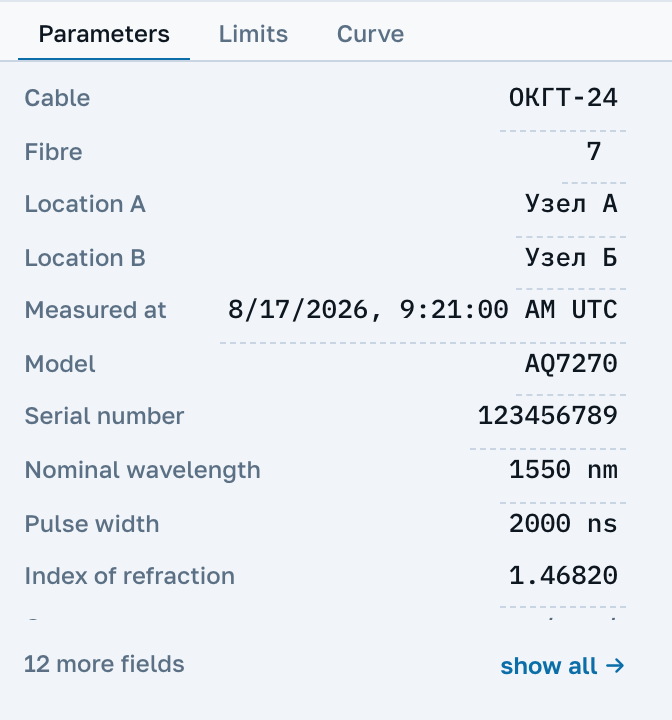
Who measured, and where
Cable, fibre number, location A, location B, operator, comment, build condition. These are the fields a report is later assembled from, and these are the ones most often wrong.
What it was measured with
Instrument model, serial number, module, software revision, manufacturer. The instrument writes them out of its own setup file, and on a swapped or repaired unit they are often wrong.
What it was computed with
Index of refraction, backscatter coefficient, nominal and actual wavelength. The index of refraction moves distances along the whole trace; there is a guide of its own for it.
What happens to the file
The original bytes are kept in full. Blocks the edit did not touch are written out exactly as they were, including vendor and proprietary blocks we do not even parse. Only what actually changed is re-encoded, while the block map and the checksum are always rebuilt. A file you changed nothing in comes back byte for byte as it went in.
Limits
Imported foreign formats (.trc, .tst, .TFW and the rest) open read-only: we do not write back into them. You can, though, explicitly build a .sor out of one, and inside it stays a record of which format it came from and what the source did not carry at all. We have no synthetic trace generator and never will: editing changes the labels and the measurement's parameters and leaves the measurement itself alone.