Knowledge base · What is this on my trace
Noise at the end of an OTDR trace
The far end of a trace breaks up when the returning light is no stronger than the receiver's own noise. More averaging or a longer pulse lifts the signal out of it; readings taken inside the noise cannot be trusted.
By Ilya (engineer, 6 years in fibre optics) ·
On this page
What it looks like
One multimode fibre from the FOA training set, 850 nm, 30 ns pulse, shot twice with only the averaging changed: the second shot has 1024 times more of it. The lightly averaged curve starts to break up more than a kilometre before the end and never reaches it. The other stays a clean line all the way to 5.6 km.
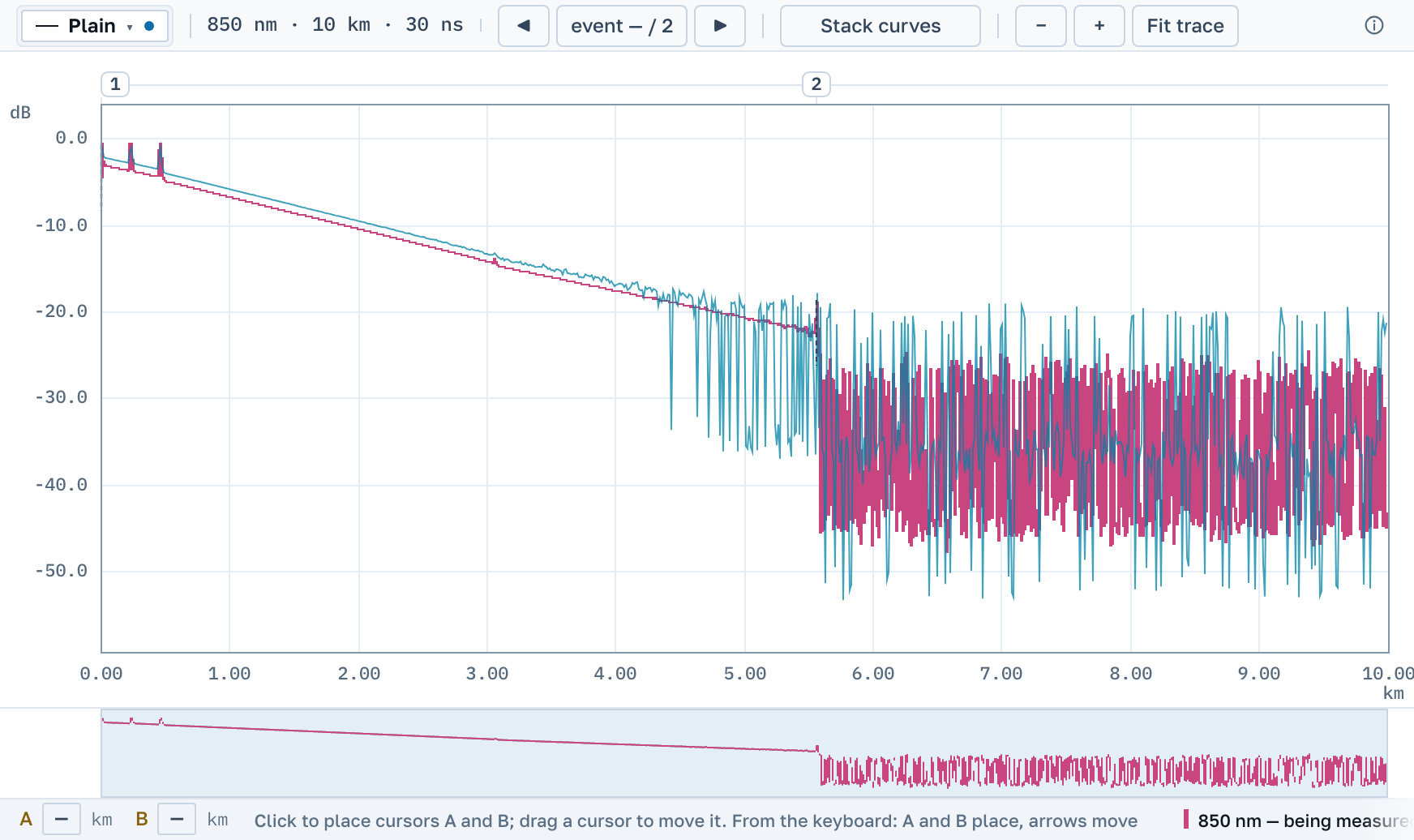
The instrument marked the end of the noisy trace at 4.68 km and of the clean one at 5.56 km. It is one fibre, and the two ends are almost nine hundred metres apart. The first end stands where the signal sank into noise, well short of the end of the glass.
Where the noise comes from
Backscatter is weak, and weaker with every kilometre. At some distance it falls to the level of the receiver noise, and from there on the trace shows the noise.
Averaging helps because noise is random and the signal is not: each doubling of the averaging time lowers the noise by about 0.75 dB, by the estimate of A. V. Listvin and V. N. Listvin in «Рефлектометрия оптических волокон». A longer pulse puts more light into the fibre and helps far more, but it is paid for in resolution: events close together merge.
Noise at the start of a trace is of another kind and does not average out, the same book notes. If the first hundreds of metres tremble on a long pulse, more averaging will not cure it.
What to do about it
- Do not read splice loss or the position of the end inside the noise. Right at the noise level the error is lopsided, and numbers taken there mislead.
- Average longer first. It only costs time.
- If that is not enough, take the next pulse width up and accept wider dead zones.
- Shoot the same fibre from the other end. The stretch that drowns in noise from this end is close to the instrument from that one.
What OTDR Master shows
Every sample the file holds is drawn; we do not smooth the curve, so the noise on screen is the noise that was recorded. The bar above the chart carries the wavelength, range and pulse of the shot, and the number of averages sits among the parameters of the file.
Put two shots of one fibre into the workspace and they are drawn together. Where the curves part, the weaker one has already gone into noise.
Where this stops
We do not smooth the trace. Smoothing would hide how much of the far end is noise, and the event table in the file was made from the noisy curve anyway.
Sources
- А. В. Листвин, В. Н. Листвин. Рефлектометрия оптических волокон. М.: ЛЕСАРарт, 2005.