Knowledge base · What is this on my trace
The OTDR put the end of fibre in the wrong place
If the end event sits short of the real length, the instrument did not see the fibre to its end. Two settings do this: a distance range shorter than the line, or too little averaging, so that the far end sank into noise.
Check the end of fibre in your own file
By Ilya (engineer, 6 years in fibre optics) ·
On this page
What it looks like
Two traces of one multimode fibre from the FOA training set, 850 nm, opened together. The fibre is 5.6 km long. Shot with a 10 km range, the curve runs to the end and drops into noise. Shot with a 2 km range, it breaks off at 1.86 km, and the instrument marks the end there.
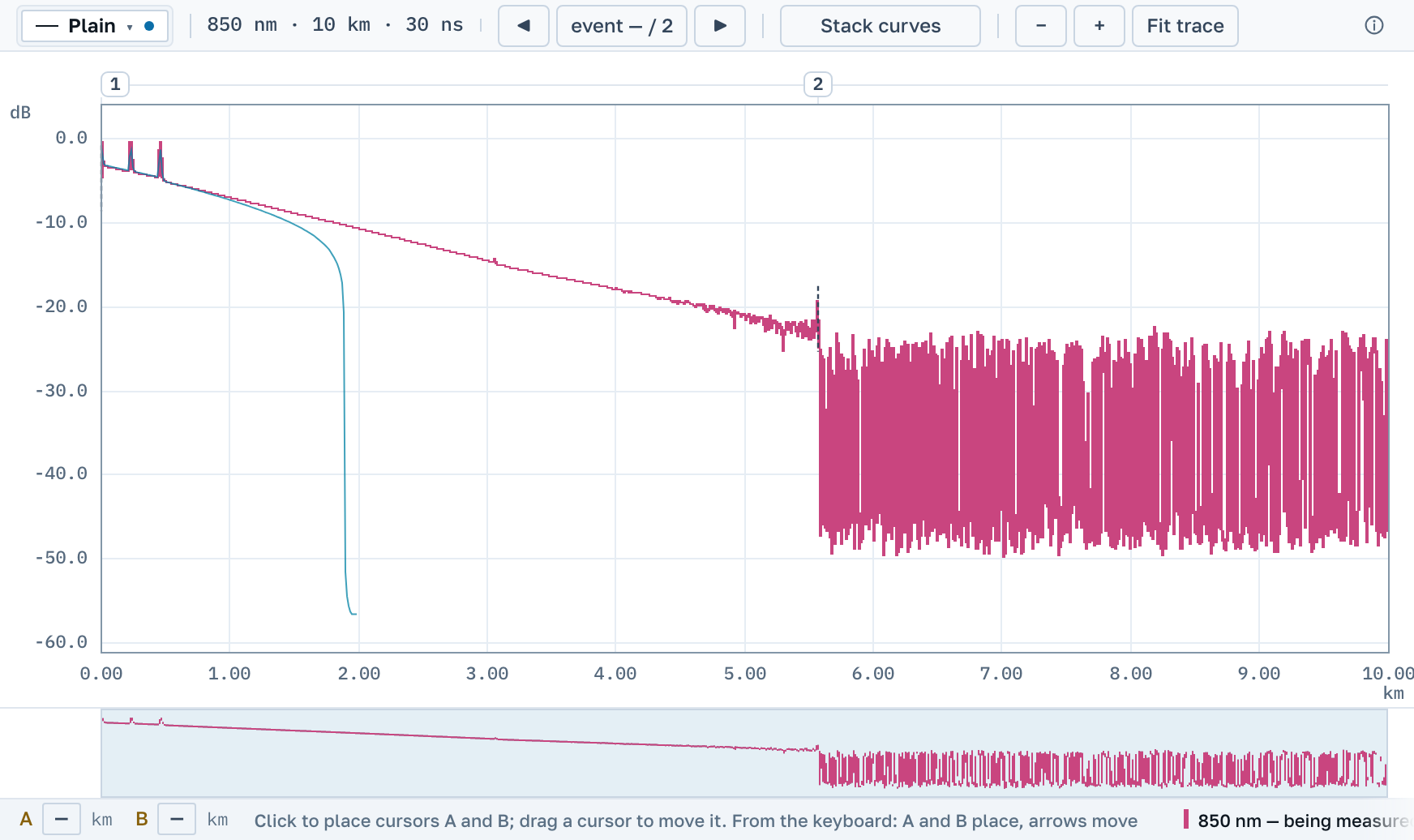
Nothing on the short trace says the fibre continues: past the marked end there is neither a reflection from the far face nor any noise.
Why it happens
The range tells the instrument how long to wait for light to come back before it sends the next pulse. With a range shorter than the line the record ends before the fibre does, and the far part of the line is not drawn.
There is a second effect, described by A. V. Listvin and V. N. Listvin in «Рефлектометрия оптических волокон». Light from beyond the range returns after the next pulse has left and lands on the trace as a false peak, at the length of the line minus the range. That distance is not a multiple of the distance to any reflection on the trace, and there is no loss step under the peak.
Noise has the same effect. With little averaging the far end of a long fibre sinks into noise, and the instrument marks the end where the signal can still be told apart. The page on noise shows this on the same fibre.
An end with no reflection, a crushed or angled break, is also placed less surely than a clean cleave: the instrument finds a reflective end by the front of its peak, and a non-reflective one only once part of the pulse has passed through it.
A bad connection taken for the end
The third cause is in the line itself. On this trace from the FOA training set the instrument marked the end at 256.6 m, where a connection stands. The level after it is about 8.5 dB lower than before it, and the curve goes on, with two more reflections at 547 m and 831 m. The file records an end-of-fibre threshold of 3 dB, and an event that loses more than the threshold is written down as the end.
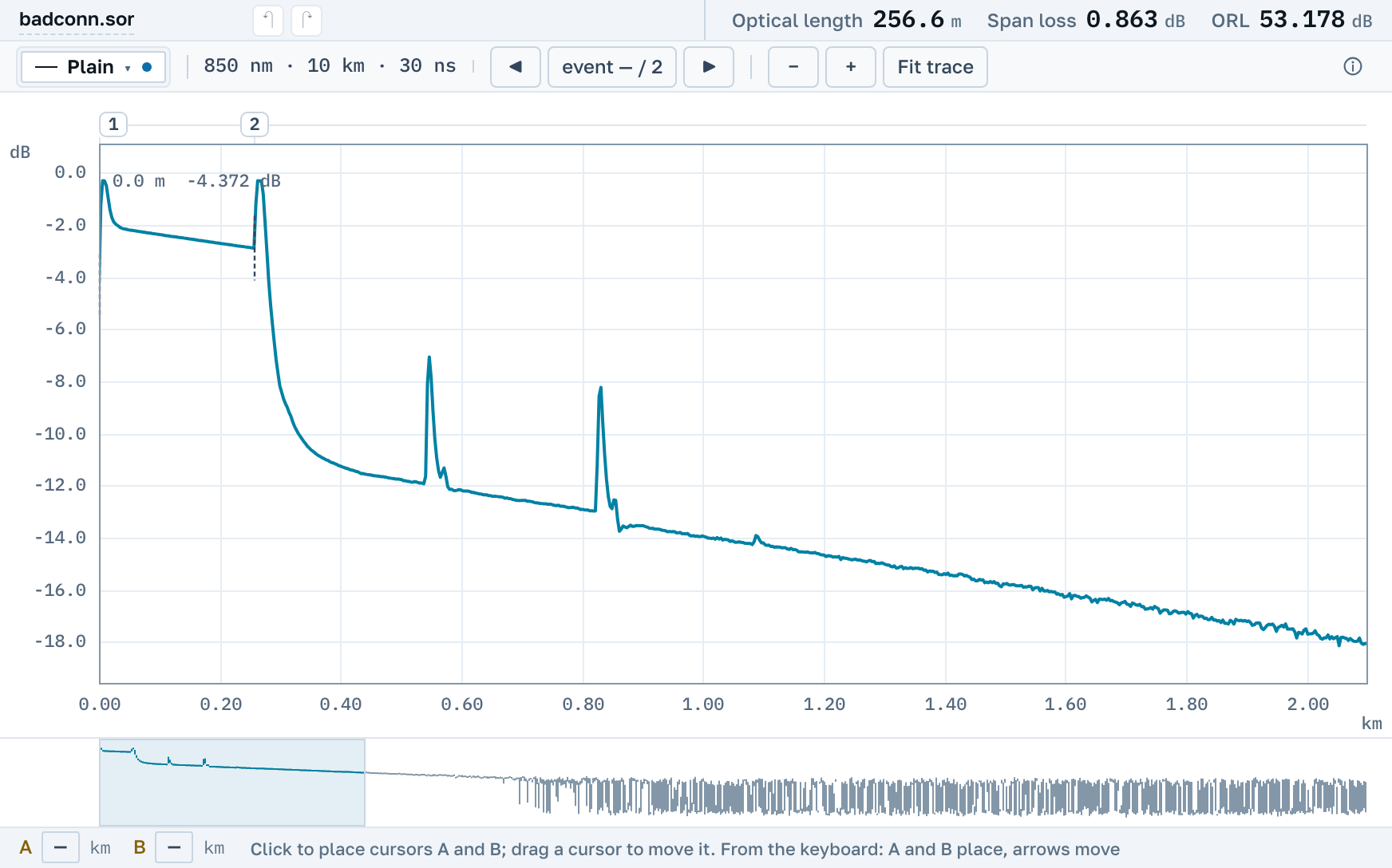
What tells this case from a short range is the curve past the marked end. Here it continues at a lower level and still carries reflections. With a range that was too short there is nothing past the end.
What to do about it
- Set the range longer than the line. The same book names a margin of 10 to 20 % over the expected length.
- Look at the trace past the marked end: a real end is followed by noise, and usually carries a reflection.
- If the end fell in noise, average longer or lengthen the pulse and shoot again.
- Before calling a short end a break, shoot again with a longer range: a break stays where it is, and an end made by the range moves.
- If the curve goes on past the marked end at a lower level, inspect and clean the connection at that spot, then shoot again.
What OTDR Master shows
The curve is drawn as the file holds it, and the range and pulse of the shot stand in the bar above the chart, next to the wavelength. Put two shots of one fibre into the workspace and they are drawn over each other, which is the quickest way to see that one of them ends early.
Where this stops
We do not move the end. In the table it stands where the instrument recorded it, even when the curve clearly goes on or clearly breaks off, and the length in the totals follows that event. A range that was too short cannot be mended afterwards, here or in any other program, because the far part of the line is not in the file.
Sources
- А. В. Листвин, В. Н. Листвин. Рефлектометрия оптических волокон. М.: ЛЕСАРарт, 2005.