Atlas · Dwei-Tech
Open an Atlas mini OTDR file on your computer
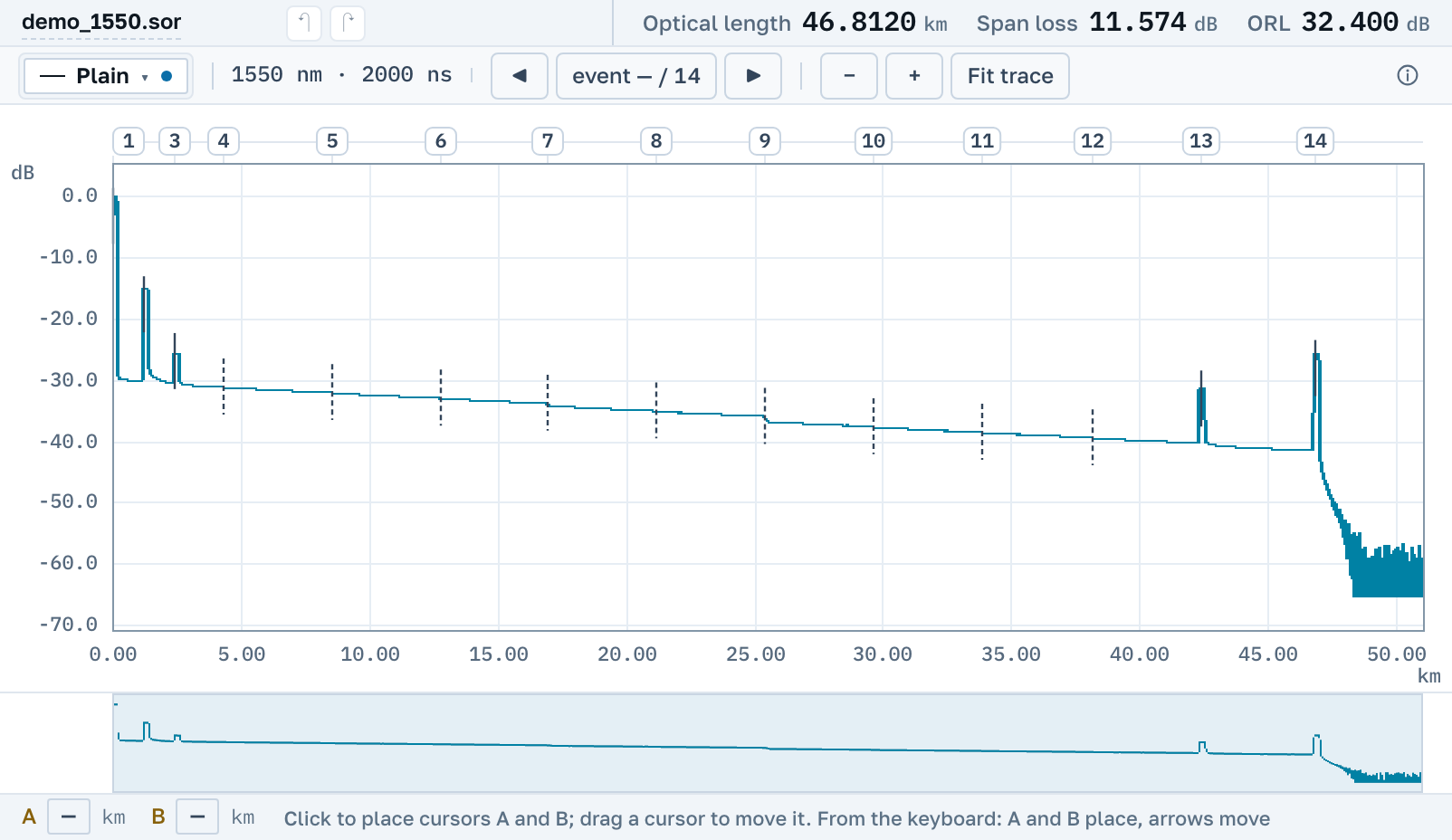
.sor files from the Atlas mini OTDR open in the browser. You see the trace, the event table and what the instrument recorded about the shot. There is nothing to install, and any operating system will do.
Inside the file the instrument names itself Dwei-Tech, whatever name is on the case. The model field is usually empty, and some units write MZ3 there. The file opens either way.
What you will see
These instruments write an ordinary Telcordia .sor. We read all of it, the way the instrument wrote it.
The trace and its events
The trace with zoom and cursors A and B, 2P and LSA readings between them, and the instrument's event table: connectors, splices, the fibre end, with loss and reflectance.
Two wavelengths together
The instrument saves each wavelength as a file of its own: 1310, 1550 or 1300 nm. Open two of them and both curves go onto one chart, each in its own colour.
A whole site at once
Open one trace, a folder of files from one ODF or a .zip archive. The list keeps every file, and you switch between them with one click.
You do not need a Windows program
The PC program that comes with these instruments is OtdrTraceView. It runs on Windows only, and you have to install it before you can look at a file.
Here the file opens by link in the browser: on Windows, macOS and Linux, on a tablet and on a phone. You do not need an account. You make the PDF report and a link for a colleague in the same place, free.
Nearby
.sor file→
OTDR trace report as PDF→
Several traces on one chart→
How to read an OTDR trace→
Downloading OTDR software, and when you do not need to→
What the events on a trace mean→
By manufacturer
OTDR Master works independently of instrument makers and sellers.